Sammi and Ronnie: When Reality TV Normalises Abuse

Updated: 2 days ago

I discovered Jersey Shore years after its original cultural peak, yet its impact on me was immediate. I admired the intensity of it all, and in ways I did not fully recognise at the time, I began to model parts of my own life around what I saw on screen. So when the relationship between Ronnie and Sammi unfolded, it felt aspirational: passionate, dramatic, intoxicating.
But as I continued watching, the illusion fractured. What had initially appeared to be red-blooded devotion slowly revealed itself as something far more damaging. Ronnie’s behaviour became increasingly volatile and manipulative, yet episode after episode, much of the house dismissed it as entertainment. Even more striking was how readily they took his side. It was clear that proximity shaped perception as Ronnie was their friend, full of laughter, ready to listen to their struggles with advice, and emotionally deep. This was the version of him they received daily, the version that is charming, wounded, and misunderstood.
Rewatching it now, I am less interested in their relationship alone and more in what our response to it reveals. How do we so easily normalise dysfunction when it is packaged as entertainment?
The Escalation of Harm
In Season 1, the harm is easier to excuse. After becoming exclusive with Sammi, Ronnie is seen at clubs getting intimately close to other women, ignoring her in public spaces while positioning himself as single-adjacent. There is even a moment of physical aggression, where he pushes her during a fight, that passes by the rest of the cast with alarming normalcy. When confronted during the reunion fallout, he does not respond with reflection but with humiliation; screaming, mocking, and creating an environment charged with hostility.
By Season 2 in Miami, the behaviour escalates. Infidelity becomes more blatant. He openly makes out with other women in clubs while still sharing a bed with Sammi. When the infamous note by 'Snooki' and 'Jwoww' exposes his actions, the issue is no longer denial but reversal. He repeatedly shouts “Because of you!” during arguments, reframing his own outbursts as her fault. Not to mention the now-infamous “Arvin” situation where the allegation was that Sammi had called a man named Arvin and invited him to Karma. Ronnie reacts as though a moral line has been shattered - accusing her of disrespecting their relationship, of humiliating him, and betraying their “love.”
Ronnie positions himself as the wounded one, as the man who sent roses, who cried, who “fought” for her, while Sammi’s wrongdoing is elevated to something completely unforgivable. Meanwhile, the audience has watched him cheat, lie, scream, degrade, and intimidate for multiple seasons. The imbalance is staggering. We see her apologising and begging for him back constantly. Internalising blame for behaviour that, in isolation, would barely register as controversial.
This is where the escalation becomes psychologically revealing. It is not simply that Ronnie’s behaviour worsens over time; it is that the standard applied to each of them becomes increasingly distorted. When he does on a rampage its simply emotional expression yet her reaction is hysterical.
In season 3, the fighting escalated to a disturbing level, crossing far into the line of abuse. What began as another argument escalated into something genuinely frightening: Ronnie ripped Sammi’s clothes from her closet, hurled her belongings across the room, tried to force her bed out of the window while she was still standing on it, and slammed doors in her face as the house scrambled to restrain him. Later, he returned and systematically destroyed what remained - smashing all her possessions, throwing them onto the porch, reducing the space she lived in to debris. Even her glasses were shattered. Sammi's belongings are an extension of her, and destroying them in this way is a threat to her being.
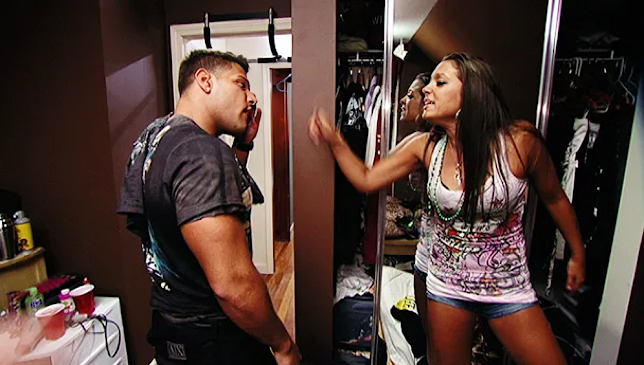
When she finally decides to leave, his reaction is almost bewildered. As if escalation was expected to continue indefinitely without resistance. The tears that follow feel less like remorse and more like panic at the loss of control. He even asked Vinny if she had apologised yet, to him and the whole house. The audacity to expect remorse from the person who had just been terrorised.
Loyalty, 'Bro-code', and Selective Vision
Psychologically, enabling thrives in close-knit groups where identity is shared and loyalty is prized above accountability. When belonging feels conditional on solidarity, challenging harmful behaviour becomes socially risky.

Yet what makes this dynamic more complex is that the enabling was not uniform. Mike often had the most strained relationship with Ronnie. Their tension meant he was sometimes the only one willing to point out Ronnie’s hypocrisy or volatile behaviour. He would call out the double standards. He would highlight the contradictions. In many ways, he could see the pattern more clearly precisely because he was not bound by the same emotional allegiance.
And yet even that clarity was inconsistent. At times, criticism became provocation rather than protection. Observations about Ronnie’s behaviour were entangled with ego battles and power struggles between the men.
From a psychological perspective, this reflects what researchers describe as diffusion of responsibility and in-group bias. When multiple people witness harmful behaviour, accountability becomes diluted. Each person assumes someone else will intervene - or convinces themselves it is not their place. At the same time, loyalty to the group distorts moral judgment. Protecting the cohesion of the “brotherhood” becomes more urgent than protecting the individual being harmed.
Isolation as Control: The Anatomy of Coercive Behaviour
Sammi did not hold the same social capital in the house that Ronnie did. He was embedded within the boys’ inner circle; their loyalty insulated him. She, by contrast, had fragile and inconsistent relationships with the other girls. She did not have a stable support system inside the environment she was living in. And that imbalance mattered.

Coercive control often thrives in exactly this kind of asymmetry. Isolation does not always look like physical confinement; sometimes it looks like narrative manipulation. When the girls came together to write the anonymous note exposing Ronnie’s behaviour, it could have been a moment of solidarity. Instead, he reframed it. He positioned himself as her only ally, subtly reinforcing the idea that the other women did not care about her, that they wanted to see her embarrassed, and that she could not trust them. And so, ironically, the exposition of his cheating only pulled them closer.
Psychologically, this is how dependency is engineered. When someone becomes both the source of your deepest distress and your only source of comfort, the attachment intensifies rather than weakens. The lower the lows, the more intoxicating the highs feel. The person hurting her was also the only one offering reconciliation.
Layered onto this is a cultural script many women are taught from a young age: that love is chaotic, that passion is proven through conflict, that endurance is romantic. “If it’s worth it, you fight for it.” “You don’t give up on true love.” “He acts like that because he cares.” These narratives blur the line between intensity and instability. They normalise suffering as devotion. Within that framework, when dysfunction is framed as depth, leaving can feel like failure.
When Production Becomes Participant
Throughout the most volatile moments, production did not merely document; it structured the aftermath. Fights were teased in trailers. Explosive clips were replayed in slow motion. Confessionals were inserted to heighten drama. The destruction of Sammi’s belongings was not treated as a safeguarding crisis, it was treated as a season-defining moment.
There is a legal and ethical tension here. Production companies have a duty of care toward cast members, particularly in high-stress, confined environments where alcohol, isolation, and volatile relationships are central to the format. Intervention is possible - security exists, filming can stop, contracts can be reviewed. And yet the pattern continued across seasons.
When harm becomes content, neutrality becomes fiction. By choosing to air, promote, and profit from escalating abuse, production moves from passive witness to active participant. The environment that enabled Ronnie was not accidental; it was sustained. And when safeguarding is secondary to spectacle, the line between documenting dysfunction and cultivating it becomes dangerously thin.
The Cost of Entertainment
For years, MTV has been abusing every member of its cast of reality TV shows to boost viewership. MTV is, in a way, comparable to being in a violent partnership. People on these reality shows are all tricked by the lure of short-lived fame and money, but they also endure a lot while on camera. If there is a problem with mental health or substance abuse, or if MTV can get some good footage out of both, they are all for it. Ron is an adult, so I'm not making excuses for him, but when it became clear he had significant issues, MTV ought to have taken him out and got him proper mental health and drug abuse treatment as soon as possible.


Comments