Ariana Grande and her Failed Relationships

Updated: Aug 11
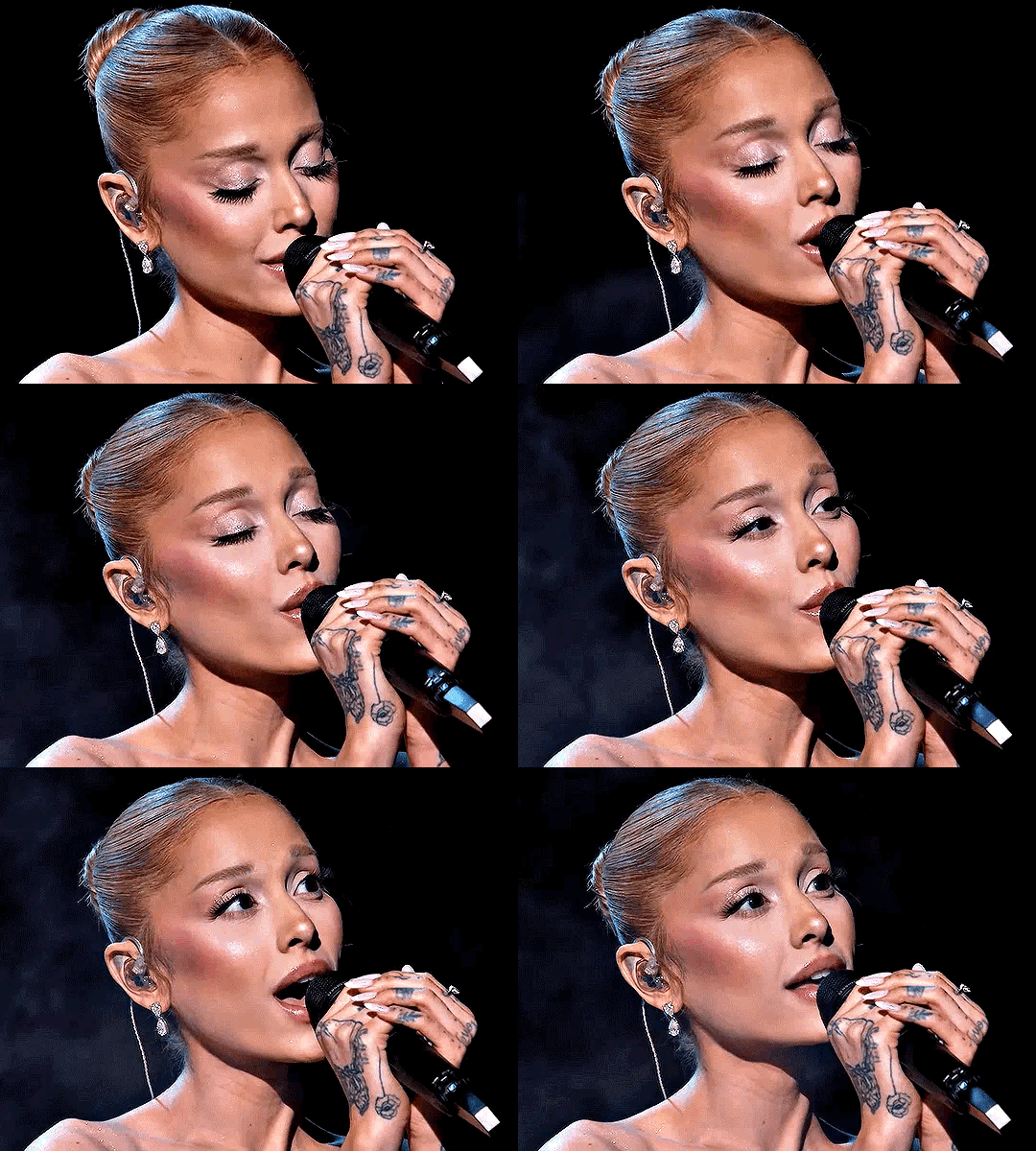
The Ethics of Celebrity Relationships
In contemporary celebrity culture, relationships are rarely private affairs. They become subjects of intense scrutiny, moral judgement and endless public debate. Ariana Grande's romantic history - often framed as a series of "failed relationships" - provides a useful lens through which to examine the relationship between media narratives and public image. More broadly, it raises important ethical questions: Where should the boundary lie between public morality and private autonomy? And what responsibility does the media have in shaping these narratives?
This article explores celebrity relationships through moral philosophy, particularly virtue ethics, alongside the legal protections surrounding privacy, to examine how public opinion often fills the space where the law does not.
The Gendered Lens of Public Judgement
Female celebrities are often subjected to a level of moral scrutiny that their male counterparts rarely experience. Grande's relationships have frequently been described using language that implies emotional instability, impulsiveness or personal failure. Male celebrities who move through similarly public relationships, however, are more likely to be portrayed as charismatic, complicated or simply unlucky in love.
This reflects broader social expectations about gender; women are still expected to embody emotional restraint and relational stability in ways that men often are not. These expectations are reinforced through entertainment media, social media and celebrity journalism, creating narratives that become accepted with surprisingly little scrutiny.
Rosalind Hursthouse argues that virtue ethics encourages us to judge a person's character as a whole rather than reducing them to isolated actions¹. Celebrity culture tends to do the opposite. Individual relationships are separated from their wider context and presented as evidence of someone's overall character. Instead of recognising the complexity of human relationships, audiences are encouraged to view them as proof of personal virtue or failure.
Public Morality vs Private Autonomy
The tension between public morality and private autonomy sits at the centre of celebrity culture. Although celebrities willingly live much of their lives in public, their intimate relationships remain part of their personal lives. Legally, this principle is recognised through rights to privacy, including Article 8 of the European Convention on Human Rights, which protects the right to respect for private and family life². In practice, however, these protections often struggle to compete with public fascination. While the law may recognise an expectation of privacy, media coverage frequently ignores the distinction between what is legally permissible to publish and what is ethically justified.
Grande's relationships illustrate this divide. Although they rarely involve questions of legality, they are routinely discussed as though they require public approval or condemnation. This raises an important question: should fame reduce a person's ability to make private decisions without constant moral evaluation?
From a socialist perspective, individual autonomy should generally be respected unless someone's actions demonstrably harm others, yet is often expanded to include public disappointment, outrage or feelings of betrayal. While these reactions may be emotionally genuine, they are a weak foundation for moral judgement.
Virtue Ethics and the Problem of Simplified Narratives
Virtue ethics offers a valuable way of understanding these discussions. Rather than evaluating isolated decisions, it asks whether a person's life reflects qualities such as honesty, compassion, integrity and practical wisdom.
Celebrity reporting rarely allows for this complexity. Relationships are reduced to simple labels - "serial dater" or "homewrecker" - that subside personal history that may effect a persons ability to critically judge the virtue of their decisions. These narratives also leave little room for changing circumstances or the possibility that private decisions may have motivations unknown to the public. Bernard Williams argued that moral judgement should always remain attentive to context³. Without that context, ethical evaluations risk becoming malicious defamation.
The Ethics of Media Intrusion
The media occupies a powerful position in shaping public perceptions of celebrity relationships.
Journalists often defend coverage of public figures on the basis that it serves the public interest. In reality, however, intense competition for attention frequently encourages speculative reporting, invasive photography and headlines designed to provoke excessive emotional reactions, leading to further divide. The Leveson Inquiry highlighted how these practices can cause significant personal harm when left unchecked⁴. Although the inquiry focused on serious failures within sections of the British press, many of its conclusions remain relevant to contemporary celebrity journalism.
The question is not simply whether reporting is lawful, but whether it is proportionate, respectful and ethically defensible. Viewed through virtue ethics, responsible journalism should seek truth while exercising restraint and compassion. Reporting that prioritises sensationalism over accuracy risks encouraging prying at the expense of empathy.
References
Hursthouse, R., On Virtue Ethics (Oxford: Oxford University Press, 1999).
European Convention on Human Rights, Article 8 (Right to Respect for Private and Family Life).
Williams, B., Ethics and the Limits of Philosophy (London: Fontana Press, 1985).
Leveson, B., An Inquiry into the Culture, Practices and Ethics of the Press (London: The Stationery Office, 2012).


I honestly think this is really well written. I love how you didn’t just focus on Ariana Grande, but used her relationships to explore bigger ideas about celebrity culture, the media, privacy and morality. The section about the different ways female and male celebrities are judged was especially interesting to me. I also really liked how you brought philosophy and law together because it makes the whole article feel much more thoughtful and academic. The “public morality vs private autonomy” part was probably my favourite because it really made me think about how much of a say the public should actually have in someone’s private life. Overall, I really enjoyed reading it and I think you approached the topic in…